


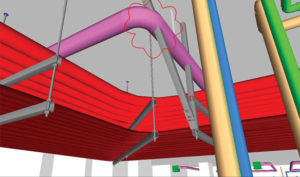
The Silent Profit Killers on Your Jobsite
Contractors know this pain all too well — your crews are ready, equipment has arrived, and then… you hit a clash.
Suddenly, ductwork won’t fit, pipes are rerouted on the fly, and your schedule slips.
Clashes don’t just delay work — they burn through labor hours, budget, and goodwill with GCs.
Here are the seven most common clashes that slow mechanical projects down — and how you can avoid them with proper BIM coordination.
1. Duct vs. Structure
The Problem: Ducts running through beams, trusses, or other structural elements.
Impact: Requires costly field rerouting, downsizing ducts, or even core drilling.
Prevention: Early 3D coordination with structural models — check clearances at every level and slope.
2. Duct vs. Pipe (Mechanical vs. Plumbing)
The Problem: Overlapping routes or inadequate clearance between ductwork and piping.
Impact: Installation crews waste hours figuring out workarounds.
Prevention: Clash detection software (Navisworks) with clearance rules — coordinate risers and mains early.
3. Mechanical Equipment vs. Other Trades
The Problem: Air handling units, pumps, chillers, or VAV boxes placed with no access clearance or overlapping electrical conduits.
Impact: Restricted maintenance space and last-minute relocations.
Prevention: Include manufacturer clearance zones in the model — check against electrical, plumbing, and fire protection layouts.
4. Pipe vs. Electrical Conduits & Cable Trays
The Problem: Parallel runs competing for the same space.
Impact: Re-routing of one trade, often after installation has started.
Prevention: Multi-trade coordination meetings and layer-based model reviews to ensure parallel routing strategies are agreed early.
5. Duct vs. Ceiling Heights / Architectural Features
The Problem: Oversized ducts that don’t fit above finished ceilings or interfere with architectural soffits.
Impact: Redesign and late submittals — project delays.
Prevention: Model with architectural backgrounds and ceiling heights locked in — coordinate elevation before fabrication.
6. Pipe vs. Slope / Drainage Requirements
The Problem: Horizontal sanitary or condensate lines clash with other trades when proper slope is applied.
Impact: Field improvisation, undersized slope, or expensive rerouting.
Prevention: Model with slope parameters enabled — validate clash-free routes at correct elevations.
7. Coordination of Penetrations and Sleeves
The Problem: Missed openings through slabs, walls, or fire-rated assemblies.
Impact: Costly core drilling, firestopping issues, and inspection delays.
Prevention: Early sleeve drawing submittals generated from coordinated model — approved before concrete pour.
The Cost of Ignoring Clashes
Each unresolved clash can cost hundreds or thousands of dollars in:
- Labor hours (crew waiting or reworking)
- Material waste
- Schedule impact
- Lost credibility with GC/owner
Industry studies estimate 5–10% of total construction costs can be traced to rework caused by poor coordination.
How to Stay Ahead of Clashes
- Invest in early BIM coordination before fabrication.
- Hold multi-trade coordination meetings weekly until sign-off.
- Use clash detection software with customized clearance rules.
- Partner with experienced BIM specialists to deliver constructible, clash-free coordination drawings.
Conclusion: Coordination = Profit Protection
Clashes are inevitable — but they don’t have to kill your schedule or margins.
By identifying and resolving these seven common issues during the coordination phase, you can save weeks of delay and thousands in rework costs.
Get Help on Your Next Project
Enphy helps contractors produce clash-free, prefabrication-ready models and shop drawings that keep projects running smoothly.
Contact us Now to get a Quote and see how we can support your next project. Or email us at [email protected]
